
A Review
Published in Mechanical Systems and Signal Processing, 2026
Fault diagnosis for rotating machinery has always been a hot research topic in both academia and industry. This review provides a holistic and concise overview of relevant studies that are categorized into three main research directions: fault mechanisms, signal processing, and machine learning. It is found that studies on intelligent fault diagnosis (IFD) today face two significant challenges: model interpretability and generalizability. Model interpretability refers to the degree to which humans can understand the decision process in IFD models; generalizability refers to the performance decrease that IFD models exhibit when tested on samples with different data distributions from the training samples. These two challenges are especially critical, given the risk-sensitive nature of machinery fault diagnosis and the ever-increasing demand for responsible artificial intelligence. At the same time, it is also observed that prior knowledge derived from fault mechanisms and signal processing is not fully utilized in most IFD studies. As a result, although many methods have been proposed to address the two challenges, the final outcome is still not satisfactory.
Recently, much attention has been paid to integrating prior knowledge derived from studies of fault mechanisms and signal processing into IFD models. This integration is effective and enlightening. However, prior knowledge and integration techniques are diverse and not systematic. Therefore, we provided a clear taxonomy and an in-depth discussion at the end of this paper to support the development and application of prior knowledge integrated IFD.
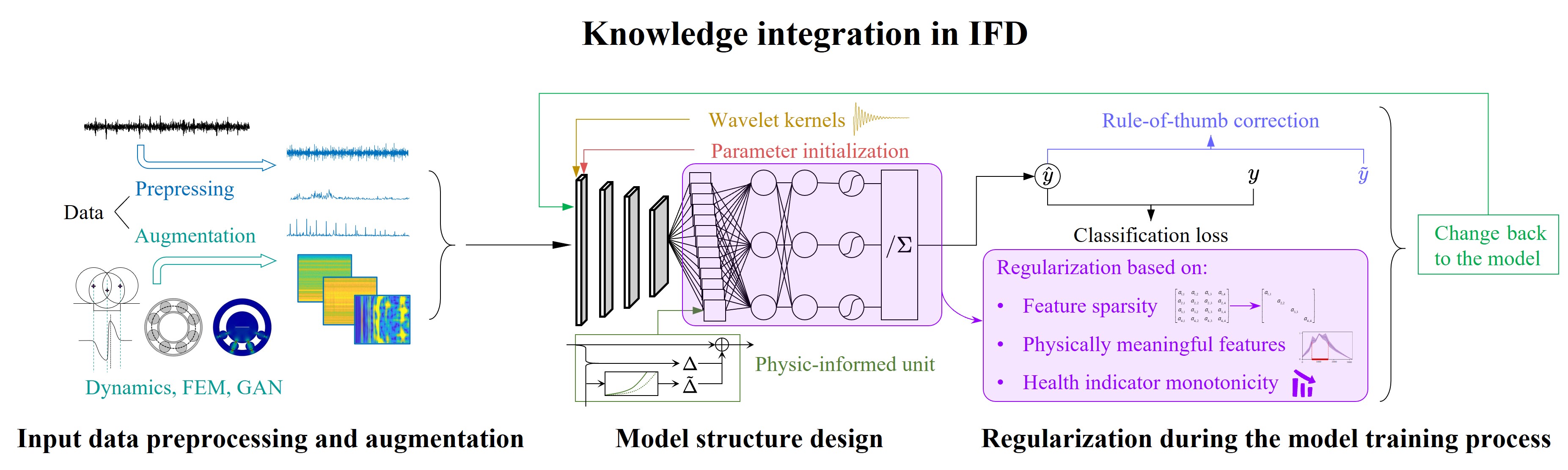
Recommended citation: Jiaming Li, Chenhui Zheng, Zhiwei Wu, Hao Chen, Xian-Bo Wang, Zhi-Xin Yang*. Review of fault diagnosis for rotating machinery: Prior knowledge integration in data-driven methods benefits model interpretability and generalizability. Mechanical Systems and Signal Processing. 2026, 242: 113623.
Download Paper